
19/03/2026
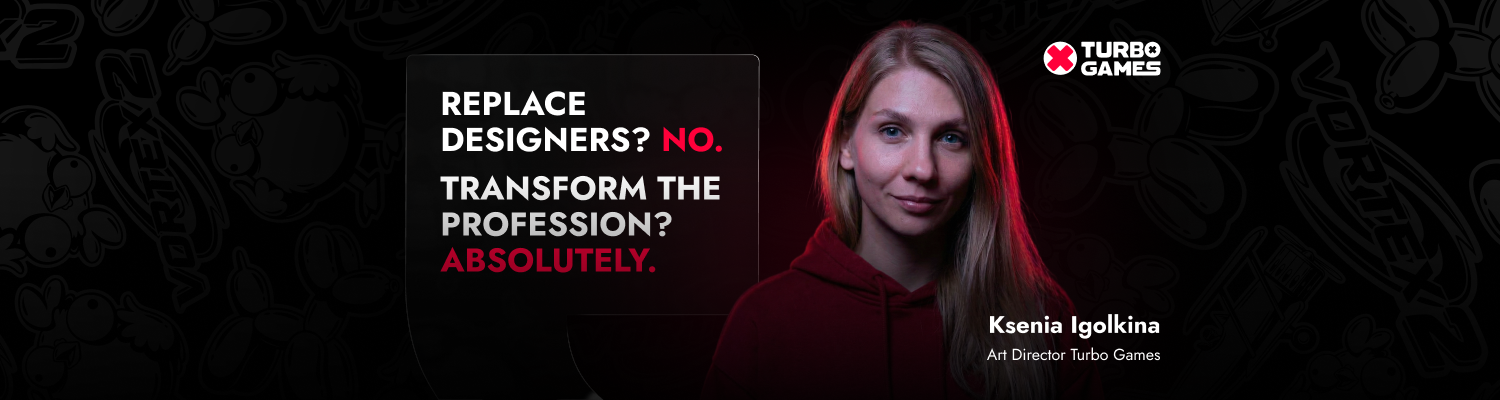
Art director, Ksenia — about AI
There’s a lot of talk about AI developing at the speed of light and soon taking everyone’s jobs. It doesn’t sound very believable, but still, this resource is now used everywhere, and the game development industry is no exception. Its pace of evolution has been very noticeable in recent years. To understand this issue, we sat down and talked with our art director, Ksenia — here’s her opinion on it:
How do you see AI impacting game design right now?
Right now, I see AI as an incredibly powerful tool for design and illustration. It’s truly a game-changer — it speeds up workflows and lifts the overall quality across the board.
AI is evolving so fast, and I feel like the design standards in our industry are evolving just as quickly alongside it. It feels great to be part of this shift. Honestly, it’s pretty exciting to be working in design right now, while all of this is unfolding.
Can AI replace designers in game dev?
Today, I still see AI as exactly what I said — a tool. A new, powerful, and impressive tool. But still just a tool.
Because of it, though, the role of a designer or artist is definitely changing. We're spending less time on hands-on production and more time shaping ideas into visuals, structuring creative flows, and learning how to translate imagination through prompts.
Here’s the thing: AI-assisted work made by an experienced designer — someone with a trained eye, good taste, and real skills — looks completely different from something generated by someone who just has access to a computer. That’s where we are now.
Looking ahead, though, with how fast AI is advancing, it's very possible that in just a year we'll be creating things far more impressive than what we can do now — faster and easier. But the design profession itself won’t disappear — it’ll just evolve. Whether we’ll still need massive in-house design teams like we did 10 years ago... that’s another question.
So, to answer your question — replace designers? No. Change the role? Absolutely.
How do you think AI will change the igaming industry in the next 2–3 years?
In the next couple of years, AI is going to transform everything. The world won’t look the way it does today — and iGaming is no exception.
What exactly will change? That’s a question for futurists. But one thing’s for sure — it won’t be boring.
Does AI lower the barrier to entry?
Honestly, I wouldn’t say the barrier to entry has changed all that much.
Sure, we’re using AI at nearly every stage of our work now. But that hasn’t made us significantly "cooler" than our competitors — because they’re using it too.
What I’m getting at is this: trying to build a new iGaming company from scratch and relying solely on AI to break ahead? That’s just not realistic.
Our industry is built on human emotion, years of hands-on experience, and the hard lessons learned by real professionals. ChatGPT can simulate understanding, but it can’t actually live or feel any of it. The human experience is something it can only describe on the surface.
So, for any young iGaming studios hoping AI alone will fast-track them to the top... well, I’ve got some bad news.
If every studio uses the same tools, how does a brand stay unique?
That’s where deeper experience and professional judgment really come into play.
We use AI heavily in our team — but with one rule: the result can’t look artificial. It has to feel crafted, like a human made it. And honestly, that takes time. But it’s worth it.
There’s so much AI-generated content out there now that audiences are starting to tune it out. If something was made in one minute — why should anyone care?
That’s why we spend extra time refining details, redrawing, polishing. Our designs take longer because we want to deliver something that actually feels like quality entertainment for our players.
What excites you most about AI, and what new opportunities does it create for games?
What gets me most excited is the speed. The fact that I don't have to grind through complex technical processes anymore – I can just bring ideas to life in the moment. That speed lets designers save their mental energy for what actually matters: being creative.
Here's the thing – back in the day, so many concepts never even made it past a conversation. You'd think of something cool, but then reality would hit: actually building that would take weeks, maybe months. So most ideas just died on the spot.
Now? We can prototype entire worlds and concepts in minutes. And more importantly, we can figure out way faster which ideas are actually worth investing serious development time in, and which ones should probably stay on the drawing board.
In the end, AI is just a tool. It makes things faster and opens more creative possibilities, but real skill, taste, and experience still matter more than ever.